
Gauri Shankar, Ganesh and Trijuti: The Rare Rudraksha Forms Explained
Nov 4, 2025
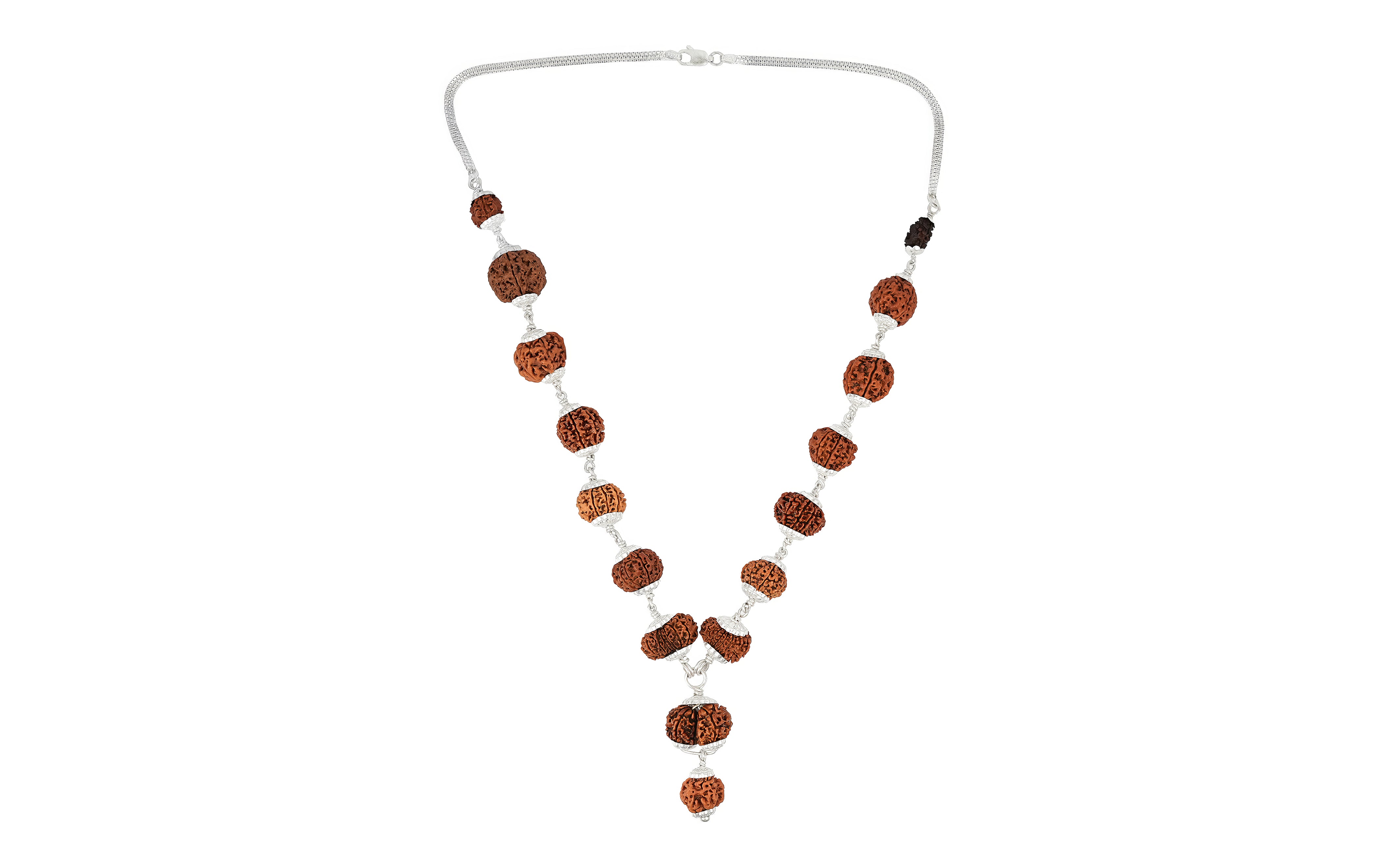
Alongside the numbered mukhis, a small number of Rudraksha grow in unusual natural forms. They are rare, they carry distinct traditional meanings, and because their value comes from shape rather than a countable line, they are the easiest beads in the category to fake convincingly.
Gauri Shankar
Two beads naturally fused together at the stem, growing as one. The form represents Shiva and Parvati united - hence the name - and it is the bead traditionally associated with marital harmony, family unity and partnership.
It is commonly kept in the home altar rather than worn, and it is a customary gift at weddings. A Gauri Shankar with mukhi counts on both halves is recorded as, for example, a 5+5 Mukhi Gauri Shankar.
Authenticity check: the join must show continuous natural fibre. Glued fakes show a clean seam, a slight colour difference across it, and often a suspiciously perfect symmetry. Examine the joint under magnification and ask for an X-ray report - a genuine bead shows an unbroken internal structure at the fusion.
Ganesh Rudraksha
A bead with a natural trunk-like protrusion on its body, resembling Ganesha's trunk. It can occur on any mukhi count. It is associated with the removal of obstacles and with new beginnings, and is a common choice at the start of a business or a course of study.
Authenticity check: the protrusion must be continuous with the bead's own surface, sharing its grain and groove pattern. A carved or glued trunk has a visible boundary, and a different surface texture from the body of the bead.
Trijuti (Tribhagi)
Three beads naturally joined - among the rarest forms in the entire category, and priced accordingly. It represents the Trimurti of Brahma, Vishnu and Mahesh, and is traditionally treated as an altar bead of great significance rather than something worn.
Genuine Trijuti are so scarce that scepticism is the correct starting position. Never buy one without a laboratory report confirming natural fusion.
Sawar
A 1 Mukhi bead naturally joined to a bead of another mukhi - most often a 5 Mukhi. Because true round 1 Mukhi Nepali beads are almost unobtainable, Sawar is the practical way most practitioners access 1 Mukhi's association with Shiva and clarity of purpose. Siddha malas frequently carry a Sawar as the guru bead.
Garbh Gauri
A larger bead with a smaller bead naturally attached, resembling a mother with a child. It is associated with the protection of children and with fertility, and is often gifted during pregnancy.
Buying any special form safely
- Never buy without a lab report. For joined beads, an X-ray or CT report showing continuous internal structure is the only strong evidence.
- Ask for photographs of the actual bead, including a close-up of the join from several angles.
- Distrust perfect symmetry. Natural fusion is rarely tidy. Two identical halves joined at a flawless plane is a warning sign.
- Compare the grain across the join. Groove direction and surface texture should flow naturally, not stop abruptly.
- Beware low prices. A cheap Trijuti does not exist. If the price looks reasonable, the bead is not what it claims.
- Buy from a seller who will accept a return on authenticity grounds, not just on damage.
Every special-form bead we list is X-ray verified and its certificate number can be checked on our validation page. See also how to identify original Rudraksha for the general checks.
You May Also Like
Can Women Wear Rudraksha? Clearing Up a Persistent Misconception
The claim that women should not wear Rudraksha has no scriptural basis. Here is where the idea came from and what the tradition actually says.
Read Full Article →
Rudraksha for Students: 4 and 6 Mukhi for Focus, Memory and Confidence
Which beads are traditionally given to students, how to combine them, and how to build a study routine around them that a teenager will actually keep.
Read Full Article →
How to Clean and Oil Your Rudraksha So It Lasts a Lifetime
Rudraksha is organic and it dries out. A ten-minute routine every few months is the difference between a bead that lasts decades and one that cracks in two years.
Read Full Article →0 Comments
Be the first to share your thoughts on this article.
Leave a Comment
Your comment will be reviewed by our team before it appears publicly.