
Camphor, Dhoop and Deepak: The Purpose Behind Everyday Puja Items
Jul 7, 2026
Most of us learned the actions of a puja before we learned the reasons. Each item on the thali has a specific role, and the sequence they are used in follows a logic worth knowing.
The five elements
A traditional puja offers all five elements to the deity, in order:
- Prithvi (earth) - sandalwood paste, kumkum, flowers.
- Jal (water) - the water offering and abhishek.
- Agni (fire) - the deepak.
- Vayu (air) - incense and dhoop.
- Akash (ether) - the bell, the conch, and the mantra itself.
Once you see the sequence, the order of a puja stops being arbitrary.
Deepak - the lamp
The lamp represents knowledge dispelling ignorance, and it is the most important single item on the thali. The flame points upward regardless of how the lamp is tilted - a much-repeated teaching about the natural direction of consciousness.
Which oil:
- Ghee - the most auspicious. Used for important pujas and festivals.
- Sesame oil - for Shani, and for removing obstacles.
- Mustard oil - for Shani and Hanuman.
- Coconut oil - common in South Indian practice.
Wick count carries meaning: one for general worship, two for prosperity, four for all-round well-being, five for a full panchamukhi lamp. The lamp is placed to the right of the deity, and lit before any other offering.
Dhoop and agarbatti
Incense represents the air element, and traditionally the dissolution of the ego - the substance burns away entirely and leaves only fragrance.
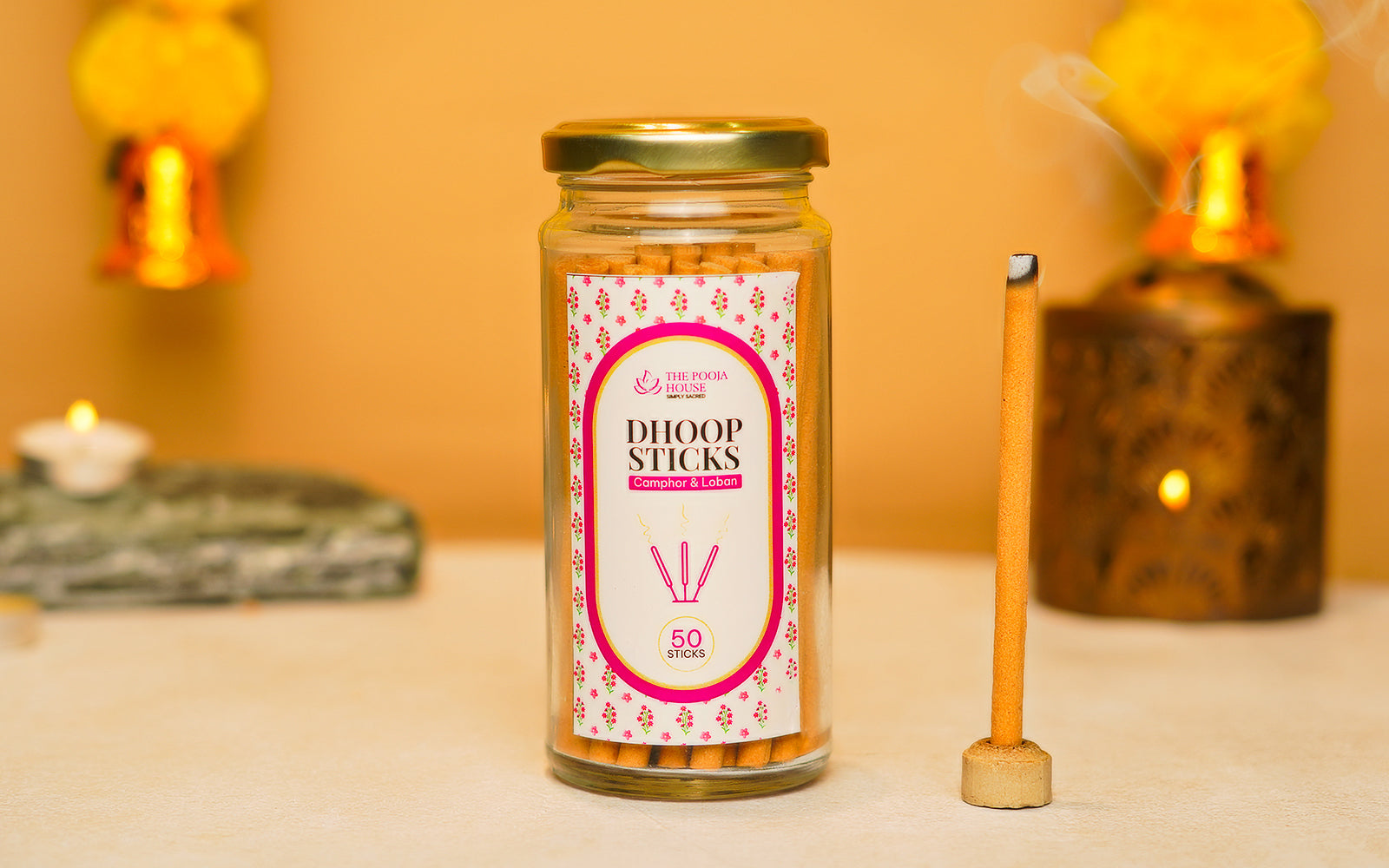
Dhoop is the thicker, bambooless form, made of herbs, resins and ghee. It produces more smoke and is traditionally used for purifying a space. Agarbatti is the thin stick on a bamboo core, lighter and better suited to daily use.
Common fragrances and their associations: sandalwood for calm and Shiva worship, loban for purification, guggul for clearing heavy atmosphere, jasmine and rose for devotional practice.
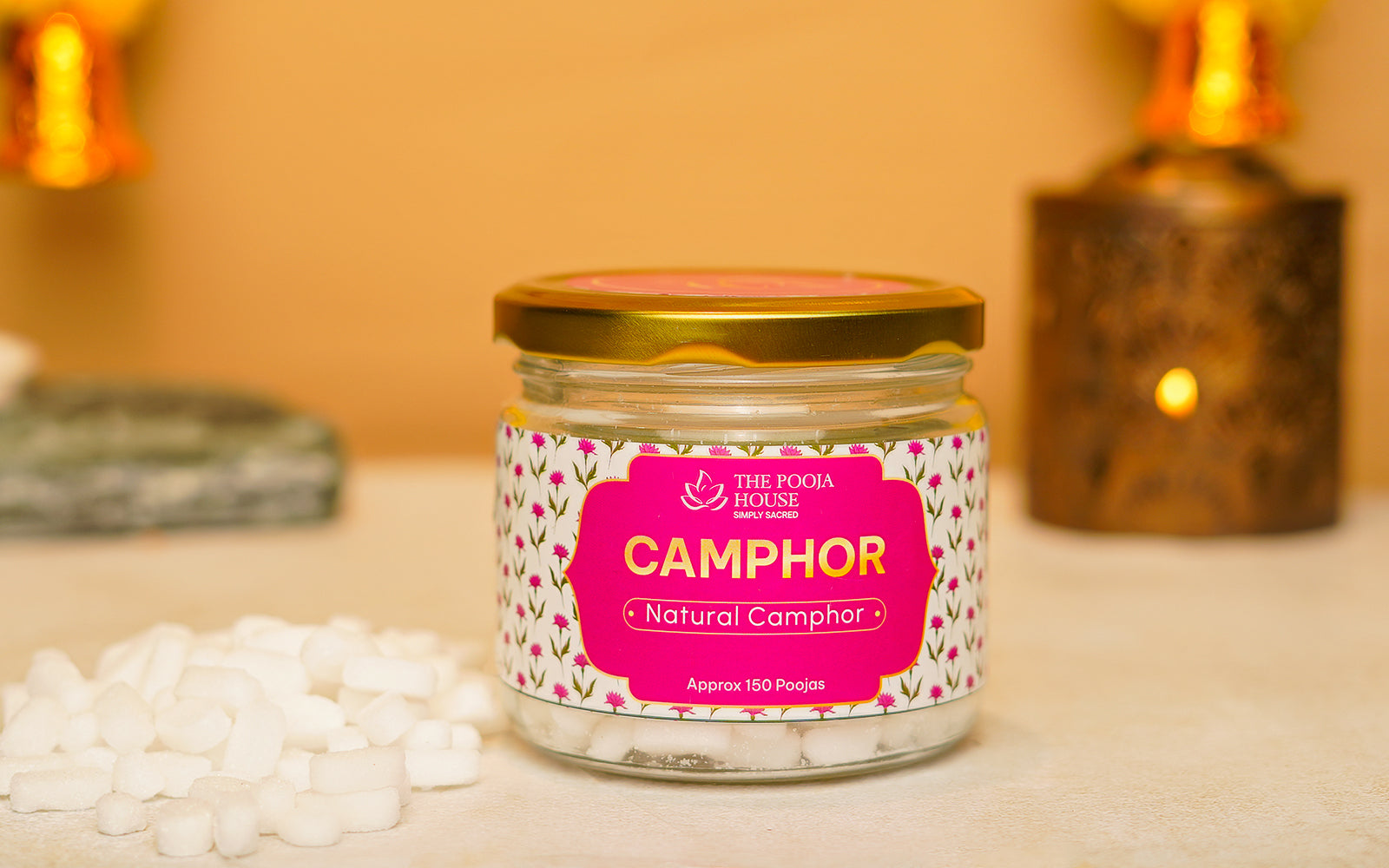
Camphor - kapoor
Camphor is burned at the end of the aarti, and the reason is precise: it sublimates. It burns completely, leaving no residue at all.
That property is the teaching. The camphor represents the ego, offered into the flame of knowledge and consumed without remainder. Nothing is left over. It is the closing act of the puja for exactly this reason.
Practical note: use natural camphor (bhimseni kapoor) rather than synthetic. Synthetic camphor is a petroleum derivative that produces heavier smoke and an acrid residue, and it is not the traditional material. Natural camphor burns cleanly with a clear flame and a distinctive fragrance.
Camphor is also burned for purification of a space, and to clear the atmosphere after illness or conflict in a household.
The rest of the thali
- Ghanti (bell) - rung at the start to mark the beginning, and during the aarti. The sound is understood to clear the space and to mask incidental noise.
- Shankh (conch) - blown at the beginning and end. Its sound is associated with the primordial Om.
- Kumkum - red, applied to the deity and the devotee, at the third-eye point.
- Haldi - turmeric, auspicious and antiseptic. Not offered to Shiva.
- Akshat - unbroken rice, coloured with turmeric. Unbroken, because completeness is the point.
- Naivedya - food offered and afterwards distributed as prasad.
- Panchamrit - milk, curd, ghee, honey and sugar.
- Kalash - a water pot with mango leaves and a coconut, representing abundance.
The usual order
- Wash, and clean the space.
- Ring the bell.
- Light the deepak.
- Offer water for the deity's feet and hands.
- Abhishek where performed.
- Apply sandalwood and kumkum.
- Offer flowers.
- Light incense and circle it before the deity.
- Offer naivedya.
- Perform the aarti with the lamp.
- Burn camphor and complete the aarti.
- Offer flowers in pushpanjali, and pray.
- Distribute prasad.
Browse puja essentials, or read Vastu for your puja room.
You May Also Like
Vastu for Your Puja Room: Direction, Layout and Common Mistakes
Where the mandir should go, which way the idols face, and what to do if you live in a flat with no room to spare. Practical Vastu, not the intimidating kind.
Read Full Article →
Sawan (Shravan) Month: A Practical Guide to Shiva Worship
Why Shravan is the most important month in the Shaiva calendar, what the Monday vrat involves, and how to observe it if you cannot take a day off.
Read Full Article →
Mahashivratri: How to Observe It and Which Beads to Wear
The night of Shiva, the four prahar puja, the fast, and why it is considered the single most auspicious time in the year to begin wearing Rudraksha.
Read Full Article →0 Comments
Be the first to share your thoughts on this article.
Leave a Comment
Your comment will be reviewed by our team before it appears publicly.